RESULTS & REports
Results
Kiwi Monitoring
Kiwi had been lost from most of the Kiwi Link area before the project began.
Listening for their return and monitoring their
progress is crucial to understanding if Kiwi Link
is on track to achieving its key goal.
Kiwi are monitored in three ways across the
Kiwi Link project:
• Annual kiwi call listening to measure
population trends
• Deployment of acoustic recording devices
(ARDs) to investigate presence/absence
• by following a small number of kiwi fitted with transmitters to measure breeding, activity
and dispersal.
Data from these kiwi monitoring methods show that overall, Kiwi Link kiwi are surviving, breeding and dispersing successfully.
Find out more about where transmittered kiwi have been tracked moving through the Kiwi Link…
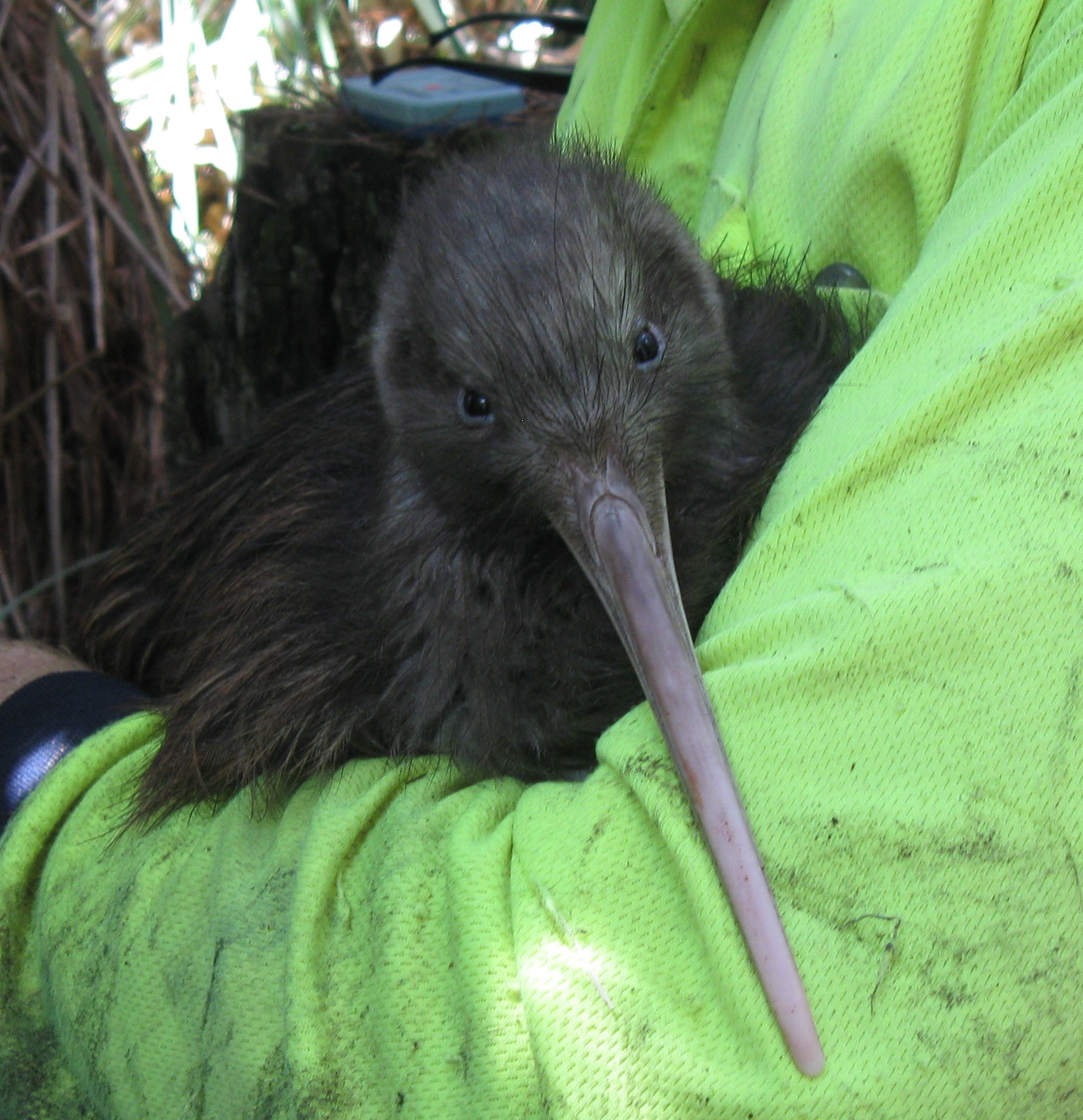
Chookie the kiwi during a transmitter change with accredited kiwi handler Todd Hamilton
(Click to make bigger)
Native Bird Monitoring
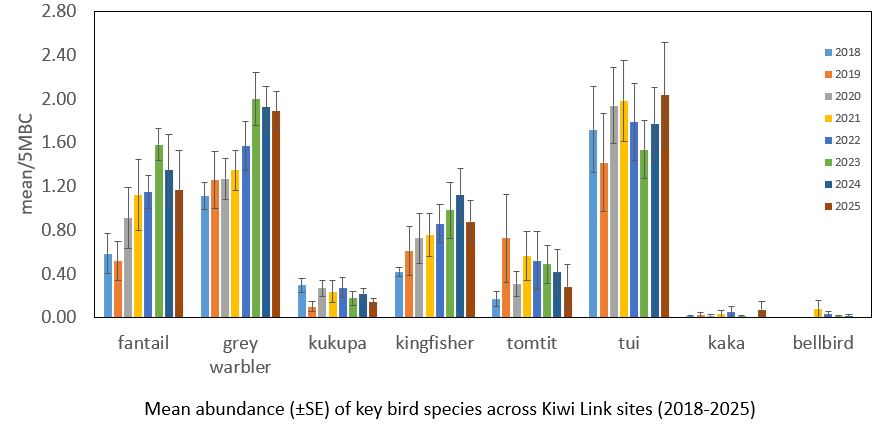
Each year key native bird species are monitored using a targeted Five Minute Bird Count methodology. Results show that native birds are increasing and excitingly, that kaka and korimako/bellbird are naturally returning to the area thanks to the sustained pest control.
Data analyst, Katie Gibb summarised the 2025 data as follows:
“Targeted native bird monitoring across Kiwi Link in 2025 provides further evidence that sustained pest control is helping native bird populations recover.
Tūī have reached their highest recorded abundance since monitoring began in 2018. Riroriro and kōtare remain well above their 2018 baseline, with kōtare showing a particularly steady, sustained increase across the monitoring period. Pīwakawaka counts have eased from their 2023 peak, but fantail are well known for boom-and-bust population cycles, so this dip alone is not cause for immediate concern.
Kūkupa were detected only sporadically, in line with their wide-ranging movements, and kākā counts remain low – likely reflecting the limits of a short, fixed-point survey method rather than true scarcity, given kākā are known to be present year-round in lower Owhiwa and Kohinui.
Overall, the 2025 results point to a stable, functioning bird community across the Kiwi Link area.”
Pest Control
The removal of 77,307 roaming animal pests over the past seven years has improved forest health and helped to restore birdsong to the once near-silent forests across the Kiwi Link area.
| Year | Possums | Rats | Ferrets | Stoats | Weasels | Feral Cats | Rabbits | Feral Pigs | Magpie | Myna | Hedgehogs | Mice | Other | Total |
|---|---|---|---|---|---|---|---|---|---|---|---|---|---|---|
| 2017 | 3,692 | 2,379 | 1 | 164 | 127 | 48 | 111 | 71 | 11 | 115 | 210 | 291 | 17 | 7,237 |
| 2018 | 2,535 | 2,607 | 0 | 178 | 134 | 46 | 69 | 99 | 26 | 76 | 183 | 208 | 83 | 6,244 |
| 2019 | 2,641 | 2,761 | 0 | 125 | 103 | 58 | 186 | 224 | 30 | 74 | 210 | 162 | 22 | 6,596 |
| 2020 | 3,843 | 2,313 | 0 | 106 | 95 | 67 | 395 | 144 | 7 | 66 | 230 | 102 | 4 | 7,372 |
| 2021 | 4,795 | 3,584 | 0 | 86 | 66 | 98 | 259 | 135 | 31 | 23 | 293 | 118 | 21 | 9,509 |
| 2022 | 3,672 | 3,171 | 0 | 102 | 93 | 90 | 248 | 66 | 34 | 22 | 230 | 319 | 39 | 8,086 |
| 2023 | 5,456 | 5,305 | 0 | 146 | 104 | 63 | 136 | 64 | 22 | 12 | 172 | 461 | 16 | 11,957 |
| 2024 | 4,426 | 4,201 | 0 | 135 | 206 | 62 | 522 | 47 | 10 | 42 | 158 | 555 | 23 | 10,387 |
| 2025 | 4,814 | 3,821 | 1 | 137 | 147 | 59 | 199 | 140 | 22 | 97 | 212 | 215 | 55 | 10,075 |
| Grand Totals | 35,874 | 30,142 | 2 | 1,179 | 1,075 | 591 | 2,125 | 990 | 193 | 527 | 1,898 | 2,431 | 280 | 77,307 |
Reports
STRATEGIC PLAN 2021-2026
Together the groups and projects involved in Kiwi Link have written a five-year Strategic Plan to help coordinate efforts, identify priority actions and track towards shared goals.
Each year Kiwi Link produces an Annual Report to show progress made towards goals, present monitoring results achieved and identify the next steps forward.
Annual Reports are compiled in July each year.
Previous Annual Reports
Talk to us
If you are a landowner within the Kiwi Link area and keen to get involved – we’d love to hear from you!
Or simply keep up to date with all our latest news and info via our social media pages or latest report!